Your Hours Worked Don’t Matter
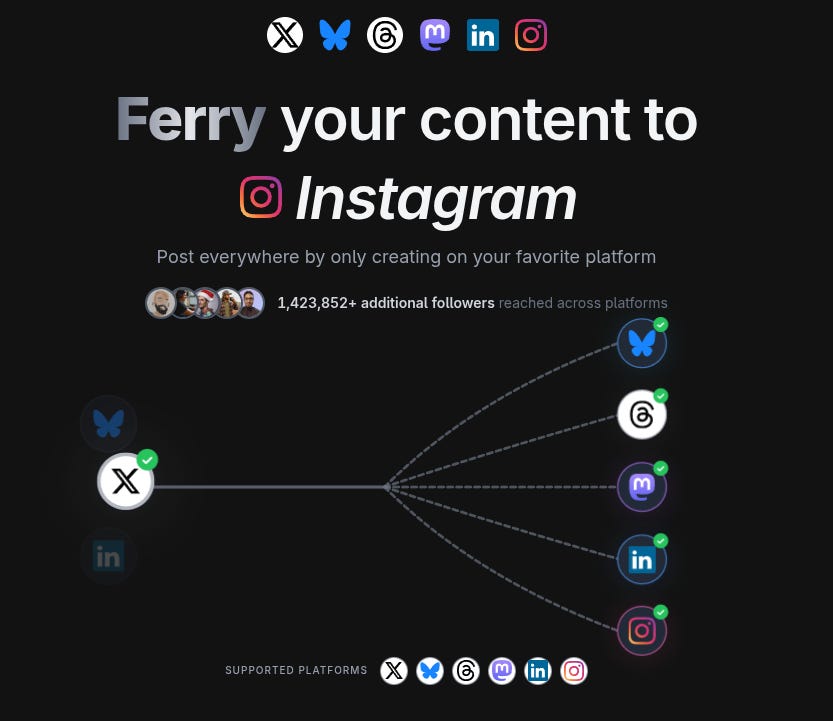
I built Ferryman to solve a simple problem: manual cross-posting is low-leverage work that drains your time. With 6,00+ posts ferried for over 270 users, the system is proven to help you grow on all your socials (LinkedIn, X, Threads, Bluesky, and Mastodon) with zero extra effort. Start scaling your reach automatically. Use code “SWEEKLY” for 30 days free of the Basic monthly plan.
When you first go self-employed, there is a massive internal pressure to fill every hour with “work.” When you don’t have a 9-to-5 schedule, being busy becomes a defense mechanism against the anxiety of not knowing if you’re going to succeed. But after eight months of building on my own, I’ve realized that this is actually a bad strategy.
You have to learn to distinguish between motion and progress. Don’t index on hours index on output. It’s easy to think that working long hours is productive; it satisfies the urge to be “productive,” but sometimes working twelve hours doesn’t actually move the needle on your core product or your bottom line. Sometimes you’ll work long hours but you’re actually just spinning your wheels. This is “productive procrastination”: doing easier, low-value work to avoid the hard, high-leverage decisions that actually matter.
Prioritize Mental Clarity
The most dangerous thing a solo founder can do is burn out before they find “the thing.” If you spend all your energy grinding on low-leverage tasks, you lose the mental clarity required to recognize a winning opportunity when it actually appears.
The goal isn’t to work the most hours; it’s to preserve your head-space. You need the ability to look at your business objectively and realize when a project is a dead end or an opportunity arises that you need to move quickly on. You can’t do that if your brain is fried from a week of fourteen-hour days. When you are exhausted, your decision-making defaults to the path of least resistance rather than the path of highest impact. You should aim to make a handful of important decisions correctly, not a large amount of decisions quickly (and likely incorrectly).
Leverage vs. Raw Hours
Working for yourself, you have a finite amount of fuel each day to make decisions. Every minute spent on a manual task is a minute stolen from high-level strategy. This is why I lean so heavily on tools like Ferryman and AI.
I built Ferryman because manual cross-posting is the definition of low-leverage work. By automating distribution, I can achieve the same audience reach in ten minutes that used to take hours of manual copy-pasting and reformatting. The same applies to my coding workflow. By letting AI handle the boilerplate and the repetitive logic, I can focus on the architecture and the user experience. Leverage allows you to achieve ten hours of output in two hours of focused work.
Value Deep Thinking
Often, the most high-leverage move you can make isn’t writing more code; it’s stepping back to realize you’re building the wrong thing entirely. You cannot see the big picture if you are buried in minutia.
Success for a solo founder is a marathon of focused sprints, bookended by lots of blank space. You need time to think, time to recharge, and, ironically, time to be bored. Boredom is often where the best connections happen. Some of my best feature ideas for Ferryman haven’t come while I was staring at a terminal; they came when I was away from the desk, giving my brain room to breathe and synthesize the feedback I’ve been getting from users.
The Cost of Exhaustion
Working past your limit consistently has an opportunity cost. Hours worked past your limit is working at a reduced capacity. This makes you less efficiently and sometimes, simply resting so you can be sharp for tomorrow work’s is a better option. If you are constantly at 10% battery, you’re only capable of 10% level work; recharging is important.
Focus on Longevity
If you treat self-employment like a sprint, you will crash. Instead, prioritize the ability to be consistent for years rather than being intense for weeks. Longevity is a competitive advantage. If you can stay healthy, focused, and operational for the long term, you give yourself more chances to eventually succeed.
Value clarity and focused, efficient, work. Success isn’t about how much you suffered to build the product; it’s about whether the product works and whether you’re still standing when it does.
Where you can find me online:
Twitch (I’ve recently started streaming)
Drop a like ❤️ and comment below if you made it to the end of the article.


